
Published: May 1, 2026
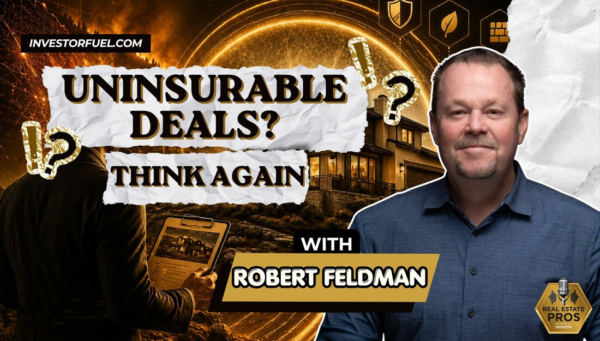
Robert Feldman, founder of WOWS Insurance Services, joined the Investor Fuel Real Estate Pros Show to share what’s really happening in the insurance market — and the practical steps investors can take right now.
If you’ve been trying to insure a property in California, Nevada, Arizona, Colorado, or anywhere in the fire-prone Western U.S. lately, you already know something is wrong. Quotes are coming back at 4x, 5x, or even 10x what they used to be. Some properties aren’t getting quotes at all. And for investors trying to run the numbers on a deal, rising insurance costs have quietly become one of the biggest deal killers in the market.
Robert Feldman has been in the insurance industry for 25 years. As the founder of WOWS Insurance Services — a wholesaler working with over 4,000 appointed brokers across 13 Western states — he’s on the front lines of this crisis every day. He points to two core problems driving the chaos. The first is aggregation: insurance companies have too many policies concentrated in high-risk areas, so when one major fire hits, carriers aren’t losing one house — they’re losing hundreds in the same ZIP code. WOWS’s response has been to build programs with Lloyd’s of London that deliberately spread risk across wide geographic areas, so losses stay isolated rather than clustered. The second problem is fire hardening — or the lack of it. Most homes in fire-prone areas simply aren’t built or maintained to resist fire, and Feldman argues that’s no longer optional. Clearing vegetation within five feet of the structure, installing fine mesh over attic vents to block embers, and sealing exposed eaves can make a home 73% more likely to survive a catastrophic fire.
He frames the investment math simply: every deal has three major cost variables. Fixed-rate mortgage payments are predictable. Property taxes are relatively stable. But insurance is the wild card — and it can move fast enough to wipe out profitability entirely. His advice to investors is to stop treating fire hardening as an added expense and start treating it as a strategic investment. Waiting until your premium spikes is too late, because many improvements take time and won’t be recognized immediately by carriers. Being proactive is the only way to stay ahead of the market.
Despite the chaos, deals that look uninsurable often aren’t — if you know where to look. WOWS maintains access to over $100 billion in capacity and writes policies up to $50 million per property. They’re also now part of California’s FAIR Plan clearinghouse, actively working to move policyholders back into the private market. Properties that can demonstrate fire hardening compliance open up a significantly wider field of carriers — Feldman’s team runs six different programs that evaluate properties specifically on mitigation criteria, giving options to properties that have been turned away elsewhere. The spread-of-risk model makes it possible to write in areas traditional carriers have abandoned: one well-hardened home in each of 2,000 different high-risk locations across 13 states can carry $10 billion in exposure and still be profitable, because no single event results in more than one loss.
Feldman expects fire hardening to move from competitive advantage to baseline requirement within the next five years. It’s already baked into California’s new construction codes — wood shake roofs and exposed eaves are no longer permitted in fire zones — and he’s currently advocating at the state assembly level for banning eucalyptus, cypress, and palm trees near structures, all non-native species he argues have made the problem significantly worse. His prediction is that fire hardening won’t be a specialized concept for much longer. It will simply be what’s required to close a deal in the Western U.S.
Insurance is no longer a line item you fill in after underwriting a deal — it’s a variable that can determine whether a deal works at all. The investors who will come out ahead in fire-prone markets are the ones who get ahead of fire hardening now, work with wholesalers who understand the reinsurance market, and build insurance strategy into their acquisition process from the start. To learn more or connect with Robert’s team, visit wowsinsurance.com or listen to the full episode on the Investor Fuel Real Estate Pros Show.